Education
Information Engineering at Gábor Dénes University; photography studies at the New York Institute of Photography; applied-photographer qualification in Budapest.
Oeuvre · Biography · Curatorial context
During the MOL Y2K project, I was working as an IT specialist. I began photographing the project on my own initiative with a basic 1.3-megapixel digital camera. That was where digital image-making entered my life. Military documentation followed later as a separate phase. The settings changed, but the question did not: how can a photograph show the person rather than merely record their appearance?

As a child I wanted to become an astronaut. I was drawn to whatever had not yet been understood. I did not end up exploring space, but the same curiosity stayed with me and gradually turned toward people.
My first profession was information technology. During the MOL Y2K project in 1999, I began photographing the work on my own initiative with a basic 1.3-megapixel digital camera. That was the beginning of digital image-making in my life. I completed an Information Engineering degree in 2005, founded the Hungarian Defence Forces’ professional photo studio in 2006, studied at the New York Institute of Photography in 2015, and qualified as an applied photographer in Budapest in 2018.
New York shifted my way of seeing in 2014. I began to treat place, person and image as parts of the same relationship, rather than placing a subject in front of a background. That approach still connects my commissioned portraits, documentary projects, books and curatorial work.
I live and work in Vienna, with Budapest remaining an active professional base. Alongside commissions and exhibitions, I teach, build photography communities and develop projects that use visual culture for education and practical community benefit.
My long-term projects have dealt with ageing, illness, historical wounds, women’s stories, fatherhood, the body and the need for touch. These subjects ask for care, patience and honesty. That is why I return to them.
I do not want to turn the person in front of me into a concept. I give them time, clear boundaries and a space in which they do not need to perform. The discipline I learned in the military is still part of the process. Its purpose is not distance, but structure and dignity.
That balance between structure and emotion also shapes my executive work. A leadership portrait and a fine-art body study serve different purposes, but both rely on trust, attention, clear boundaries and the ability to recognise presence without forcing a performance.
A serious accident forced me to stop and ask what photography was for. I realised that a well-made image was not enough. The work had to matter to the person in front of the camera as well. That decision still shapes my portraits and long-term projects.
New York taught me something different. I arrived with little money and a clear idea. People helped, doors opened and the project moved forward one conversation at a time. Since then I have relied on preparation, human connection and the willingness to begin before every detail is settled.
Recognition followed, including the OM SYSTEM Ambassador role. I value it. But the projects that stay closest to me are the ones that became useful beyond the photograph: the oncology exhibition created with almost a hundred contributors, the community portraits that helped a school, and the workshops where knowledge keeps moving from one person to another.
That is also how I think about a commission for a leader or an organisation. The photograph matters. What it helps build afterwards matters even more. Read the longer interview ↗ · Read the Vienna portrait ↗
While working as an IT specialist on the MOL Y2K project, I begin documenting the project on my own initiative with a basic 1.3-megapixel digital camera.
Information Engineering degree, followed by the founding of the Hungarian Defence Forces’ professional photo studio.
New York projects, major portrait exhibitions, NYIP studies, an applied-photographer qualification and three interdisciplinary books.
Becomes an Olympus—now OM SYSTEM—Ambassador; a permanent exhibition opens at the Csolnoky Ferenc Hospital Oncology Centre in Veszprém.
Co-founds and curates the digital Rege Gallery in Tihany; The Frame, NFT and AI projects examine how images change in digital culture.
Launches Hungarian-language photography education in Vienna and helps develop the community that later operates internationally as VIPACH.
Community portrait fundraisers support the Vienna Hungarian School’s climate-control and piano projects.
Joins AmCham Austria and the World Federation of Hungarian Photographers; launches the free Be Smart Kids Club for Hungarian-speaking young people aged 10–16.
Information Engineering at Gábor Dénes University; photography studies at the New York Institute of Photography; applied-photographer qualification in Budapest.
OM SYSTEM Ambassador; honorary member of the Pannon Photographers Association; member of WKO professional photography, AmCham Austria and the World Federation of Hungarian Photographers.
Art to Go charity action, Vienna photography workshops, community portrait fundraisers and the free Be Smart Kids Club connecting digital skills with nonprofit service.
Fine-art record
Exhibitions, books, long-term artistic projects, curatorial programmes, press records and preserved sources are maintained in the canonical BANHALMI ART archive. This professional site keeps only the artistic context needed to understand the commissioned practice.
Alongside the independent oeuvre, I have worked across executive portraiture, editorial and brand photography, international sporting and cultural events, campaigns and institutional communication. The professional context includes assignments or collaborations connected with Coca-Cola, Samsung, Olympus / OM System, the Dutch national football team, international conferences and a wide range of private and corporate clients.
Today the work is based between Vienna and Budapest and can expand through selected photographers, retouchers and coordinators when the scale of a project requires it. Visual authorship and final responsibility remain centralized.
The archive provides project histories, social context, visual language, locations, dates and links to original exhibition pages.
The services show how the same long practice is translated into clear processes, predictable delivery and images with a defined use.
Selected Google reviews remain available in a quiet, collapsible section for visitors who want independent reassurance.
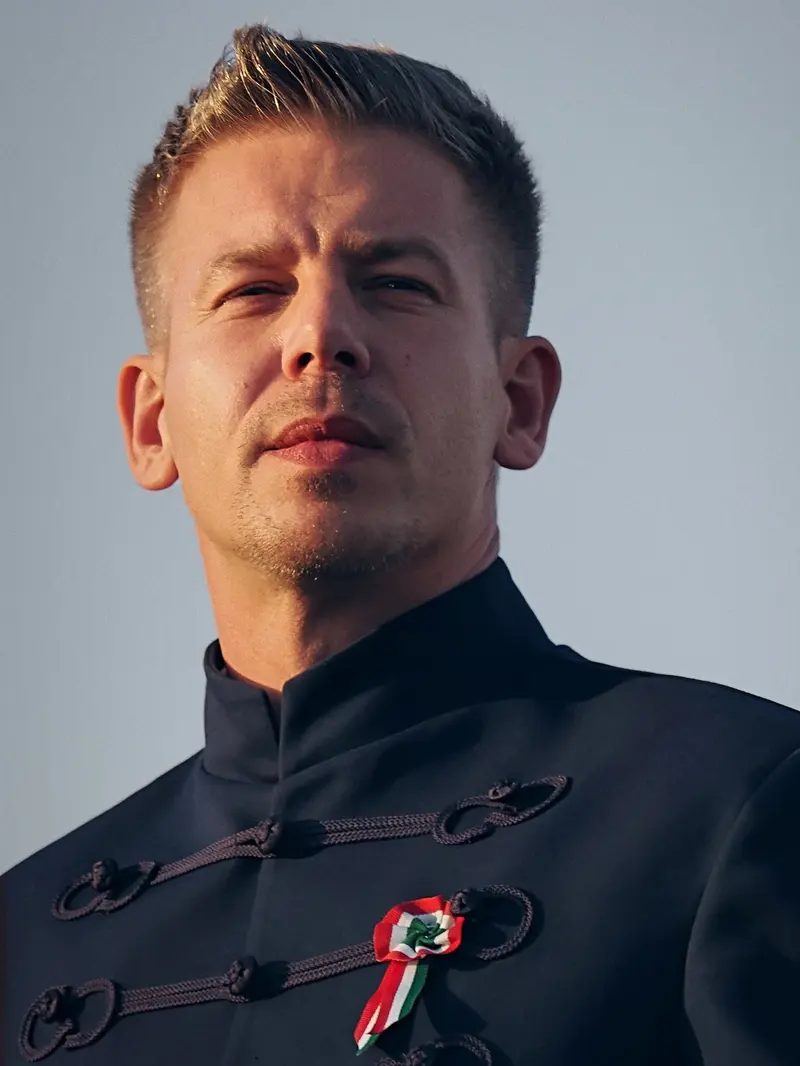
I photographed Péter Magyar at Heroes’ Square in Budapest on 15 March 2026 at 16:57 as the first work in EUFÓRIA – The Anatomy of Presence, an artistic project conceived as a contemporary homage to Robert Capa’s principle of proximity. Wikimedia Commons records the creator, depicted person, date, location, project relationship and CC BY-SA 4.0 licence.
The open licence allowed the portrait to move independently through encyclopaedic, educational and editorial contexts. The documented uses below include publications from different countries and sharply different political viewpoints. Their inclusion records the photograph’s reuse and attribution only; it does not endorse the articles’ political framing.
Norbert leads visual strategy, photography and final image decisions. BANHALMI operates the Vienna studio at Schwedenplatz, a separate Vienna office/client meeting location at Gersthofer Straße, and the Budapest studio. Viko Speier leads the Budapest studio and supports preparation and client coordination. The detailed team structure is maintained on Viko’s profile.